
The Limewash Effect
A Forest, A Feature Wall, and Reclaiming My Writerly Compass

Unlike the rest of The Launch Diaries, this personal essay is not overtly about writing. My hope is that writers will be glad they humoured me anyway.
In the thirteen years we’ve lived in our house, the forest behind it has quietly, wildly flourished, until one day this past September I was flicking on the lights in the middle of the afternoon, trying to read the mail. What happened to all the light??
These walls were a lovely gray. When had they morphed to swampy green? Why does the open-concept kitchen feel like a cave?
My husband walks in, clocks my expression, and freezes like a squirrel in traffic. Things are about to go one of two ways: I’m going to disappear into a draft for the rest of the day and we’re ordering pizza for dinner, or I’m going to rope him into a DIY mission for the rest of the day and we’re ordering pizza for dinner. (Bless this man, he’s ride or die either way.)
We agree: it’s time to repaint the room. But the paint chips only serve to escalate the wrongness of the stone veneer around the fireplace opposite the kitchen. Did we really choose this colour on purpose? Has it patina-ed? Am I getting cataracts?
Cue the research rabbit hole. We land on limewash to color shift the stone, and I’m all for it—then hesitant to begin. This stone holds a story, and we’re about to cover it up: travelling on a wintery Saturday to choose it, the lineup long and our coats heavy, our toddler mercifully patient on my hip, then later, “helping” her daddy butter the mortar in the spot I’m currently standing.
But the fact remains the stone as it is no longer goes, you know?
My husband and I crank the music, roll out the drop sheets, pre-fuel with scrambled eggs. To our shock, our daughter (now a teen) comes out of her room and joins in. This go-around, she isn’t “helping” with the fireplace stone, she’s helping. Our lower backs are applauding. My eyes won’t quit leaking. Together, it’s light work, until we realize Google fed us the wrong steps for the distressed look we’re after, so there are several more hours of comically weary scrubbing. At last, we’ve nailed it. We love it—more so for how it’s second act has come to be.
Back to the wall paint. Except now, my husband is making his idea face, because the walnut-stained kitchen cupboards don’t look so great opposite the newly tinted stone.
We marinate on this, pacing from kitchen/family room into the dining, which is also the living, which is basically the front entry. All are painted the same too-dark, gray-turned-green as the kitchen walls.
And that, dear reader, is how we end up microwaving soup in the basement for a month, the full contents of our kitchen boxed up around us, the main floor of our bungalow inaccessible and the air reeking of cut onions (because paint fumes). The expanded scope has called for professional reinforcements, and more time and money than we’d budgeted.
At the literal center of it all is one wall, a narrow space we pass by a zillion times a day en route to everywhere else, and the first thing you see when you walk in the door. I’d always wanted it to be a feature wall, but couldn’t land on what sort until researching limewash sparked an idea. I can see it in my mind, and I am going to do it myself: textured, subtly shifting ivory-taupey-grey, like indifferent cloud cover. (I also have a screenshot of the look saved on my phone).
Google’s AI tells me how to achieve it, but it doesn’t sound right. The tint of the limewash the guy at the paint store hands to me doesn’t look right either, but he assures me limewash takes multiple coats and will look very different after a few days.
I ignore my doubts, and do four coats. I wait two weeks.
Friends, it’s AWFUL.
It’s coconut cream pie rolled in sand and left in the rain, and I’m seriously losing my shit:
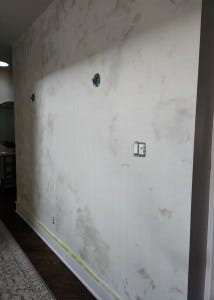
Paint store guy appears to have entered witness protection. No other stores in my area carry limewash (though one industrious fellow tries selling me regular paint in the colour “Limewash”). I ask the crew painting the kitchen for advice, but they shake their heads, like I’m speaking Latin. Like what I’m envisioning does not exist. Except, limewash is definitely a thing? Also, I’ve got a screenshot?
Perhaps I didn’t dilute it enough, one suggests, and did I know you need a special brush? (I did. I do.) Another says no, no, you don’t DILUTE it! You apply it super thick, with a trowel! Google, helpful as ever, agrees with both, it just depends on the prompt.
I now regret starting at all. I can’t sleep with this wall how it is, but the lime texture smothered across it has left no easy fix. The painters are full of suggestions: wallpaper, wainscoting, bead board, ship lap. Geometrically-arranged slats painted black. VERY on trend! We can do that for you no problem!
Except it’s a problem for me, because nothing against any of those options, they’re not at all what I want for here, and now I feel like I’m being difficult. But like the fireplace, every time I look at this wall I’m going to see its story. And currently, that story reads: you tried, you failed, and this isn’t what you wanted, just the substitute put forth by a bunch of men who don’t live here on their way to the next job.
And wow, have I lived this story before. Had this conversation countless times in the six years of wrangling my debut novel from the stubborn grip of my soul into physicality. So much knowing without knowing the how, my insides insisting on what my hands couldn’t shake free, oodles of well-meaning professionals looking at me like I was speaking Latin. Like the suggestion alone of a story told from nine points of view was outrageously audacious.
It’s not possible.
It will never work.
Why don’t you try something else?
So now, it’s become a whole thing, and as much as we’d all love to access this hallway again, I am going to stand here and figure out the damn limewash effect even if it takes me six years.
Then, a whispered aside from the lone female on the crew. New on the job, slight in stature (but, I’ve noticed, triple the hustle and heart of all the men combined).
“I know what you’re talking about.”
I nearly hug her. “You do?”
She nods, pulls up a TikTok (of course she does) that reveals the technique behind my screenshot. (And shocker, there’s zero overlap with anything the paint store guy, the pro painter guys, or Google’s AI have told me.)
I wake up early the following Sunday; my family have again offered to help, but this one’s all mine. For the next several hours, there is only me and the wall, that incomparable rush of mind’s eye sliding within fingertips’ reach, the back-and-forth sweep of the brush in my hand like first love at a ball.
Coat one is messy, but in a way that leaves no question that this time, I’m on my way:
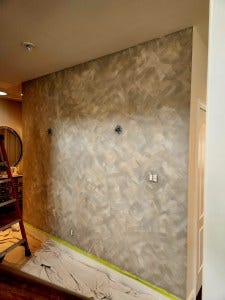
It’s working. I just need to trust the process.
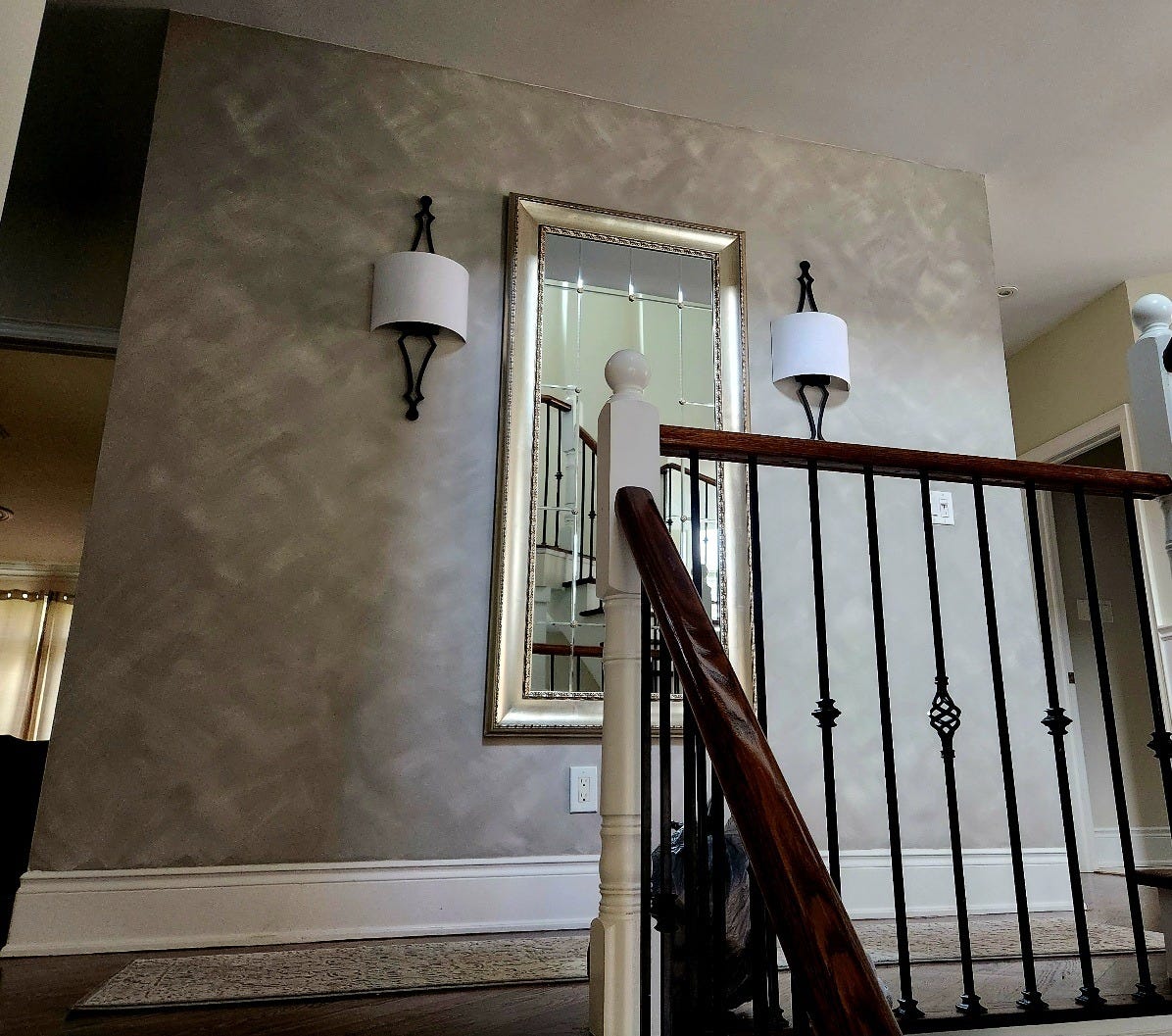
In the end, the finished product (below) is everything I envisioned, only better because my previous attempts—chalked up as failure, a waste—have bled through in the best way, lending a texture much richer than expected.
Weeks later, I’m still smiling whenever I walk past, often as I wrestle with that second book (which is proving harder to shake out than the first). The wall has become my quietly persisting you got this, a gently twirling collection of all my hardest-learned lessons:
The path back to sunlight is seldom straightforward, and almost always involves a forest.
Keep the emotion, but keep moving forward. You can shift the color without losing the substance.
Know when to call in the experts. Know when to ignore them.
Nothing is wasted; every effort finds some way to add to the next.
The internet will misguide you more times than it saves you.
When the men in the room start looking at you like you’re crazy, you’re onto something.
The woman in the room who’s afraid to go full-voice in case she doesn’t know what she’s talking about is often the one who most knows what she’s talking about.
All you need is one person who believes you. Until you find them, that person is you.
When people say “you can’t,” sometimes all they’re really saying is “they can’t.” (Or don’t want to).
Trust the process. The vision is never random; it chose you for a reason.
Thanks for reading The Launch Diaries!
Love the outcome, but I love the description of the process even more. Thanks for the wisdom!
What an adventure! And so well told—as usual. Humor and heart. And a HEA: beautiful wall, grit, and lessons of grace. I’m so glad I’m a subscriber. I’d hate to miss this one.